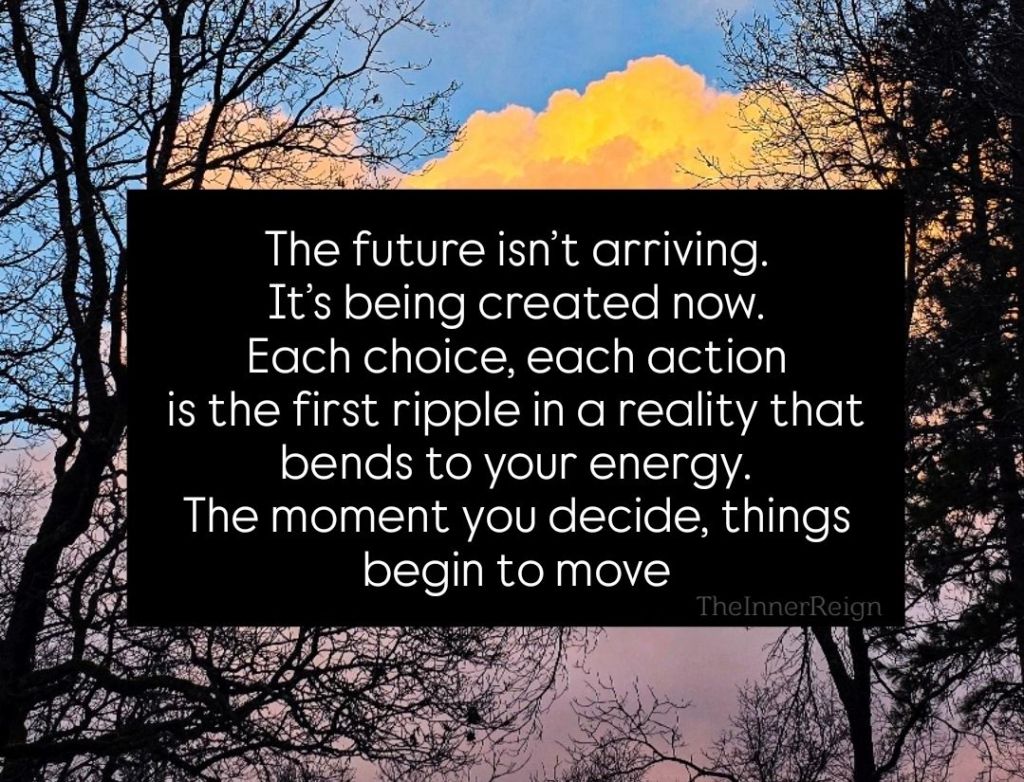
We keep asking the wrong question.
“What’s wrong with the world?”
When we should be asking:
What do we need to understand in order to bring it back into harmony?
The answers are not hidden in distant policies or grand revolutions. They live in the subsurface, intimate places where every human life actually begins: in our attention, our nervous systems, and our relationships with one another, ourselves and the living world.
Here are three truths simple to grasp yet deep enough to reshape civilizations (if we genuinely understand them and live them.)
1. Attention Is Creative Power
Most of us still treat attention like a passive flashlight, merely illuminating whatever happens to cross its beam.
It is not.
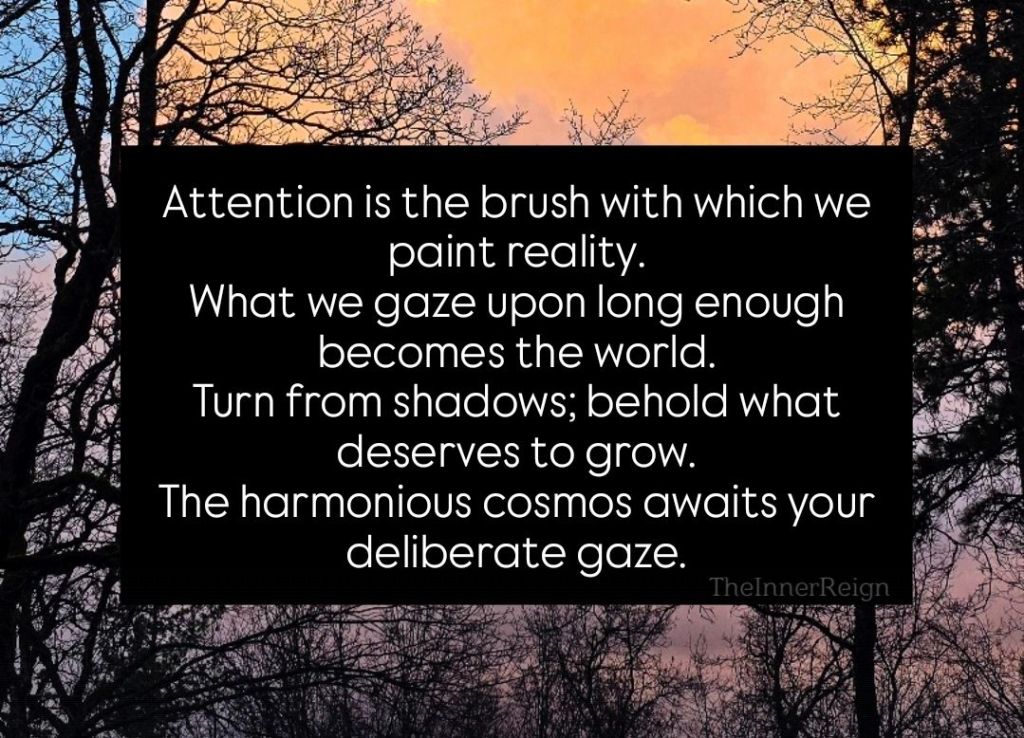
Attention is the raw material of reality itself. In physics, the act of observation collapses possibility into actuality. In the brain, repeated focus carves deeper neural grooves until they become automatic. In culture, collective focus builds empires of thought, economies of emotion, and entire social realities.
Where attention goes, reality grows.
This is not woo-woo poetry; it is observable law. Every algorithm you train with your scrolls, every outrage you rehearse in your mind, every beauty you linger on, all of it is creative energy flowing through you into the world.
Putting it into practice
Daily:
– Replace doom-scrolling with deliberate creation.
– Follow the builders, the healers, the quiet revolutionaries instead of the loudest voices.
– Give your minutes to what you want more of.
Inner:
– Catch yourself rehearsing fear or resentment, then gently pivot, like turning the wheel- toward vision, solution, gratitude.
Social:
– Share constructive ideas more often than complaints.
– Amplify the innovators and the kind ones.
When enough of us treat attention as sacred, the world tilts toward whatever we have chosen to nourish.
2. Unresolved Trauma Becomes Collective Policy
Every major conflict on the planet is, at root, unhealed nervous systems acting at scale.
Unprocessed shame becomes domination.
Unprocessed fear becomes control.
Unprocessed abandonment becomes the relentless pursuit of power.
What we refuse to feel and integrate as individuals leaks outward and hardens into laws, institutions, and cultural norms. The personal is not just political, it is infrastructural.
A harmonious world is not built by emotionally unregulated adults trying to fix broken systems. It is built by emotionally regulated adults who no longer need the systems to soothe their unhealed parts. Healing is not soft. It is the hardest, most radical infrastructure work there is.
Putting it into practice
Personal responsibility:
– Learn your triggers like you would learn the weather patterns of your own inner climate.
– Pause before reacting. Feel the emotion fully instead of discharging it onto others.
Nervous-system hygiene:
– Prioritize sleep, sunlight, movement, breath, and real human touch, the non-negotiables of a regulated body.
Relational repair:
– When you rupture, repair.
– Say the simple, humbling words: “I was wrong. How can I make this right?”
If millions of us commit to this subtle discipline, the large-scale systems we complain about will begin to shift, not because we forced them, but because the human material they are made of has changed.
3. Interdependence Is Not Weakness It Is Design
The myth of the hyper-individual has sold us a devastating lie: that strength means standing alone.
Nature laughs at this idea.
Forests feed one another through vast underground mycelial networks.
A single cell only survives by collaborating with trillions of others inside your body.
Every thriving ecosystem balances competition with profound cooperation.
Humans are no different. Your thriving has always been tied to mine. The illusion of separation is what destabilizes us; remembering our design is what restores us.
Competition has its rightful place, it is a fire that forges excellence. But cooperation is the soil, the water, and the sunlight that lets excellence endure across generations.
Putting it into practice
Shift the daily question to “How do we build?”
– Invest locally: support neighborhood farmers, know your neighbors, build real-life community.
– Create value loops: mentor someone younger, share hard-earned knowledge freely, circulate resources instead of hoarding them.
– Think in seven-generation time: before any major decision, ask, “Would my great-grandchildren thank me for this?”
The World We Actually Want
A harmonious world does not begin in Washington, Brussels, or Davos.
It begins in your next breath, your next purchase, your next meal, your next scroll, your next conversation.
It begins when we stop feeding what we don’t want to grow.
When we regulate ourselves before trying to regulate others.
When we remember that we were never meant to go it alone.
The simplified version:
3 Things Humanity Must Understand Right Now
• Attention is creative power, stop feeding what you don’t want to grow.
• Unhealed trauma becomes systems. regulate yourself before trying to fix the world.
• Interdependence is design. build together, not just for yourself.
A harmonious world doesn’t start with governments.
It starts with nervous systems and attention.
And it can start today, with you.
Choose where you place your attention.
Choose to heal what aches inside you.
Choose to reach out and build with someone else.
The future is listening.
What will we bring into being?
 Soulfully Rich
Leave a comment